
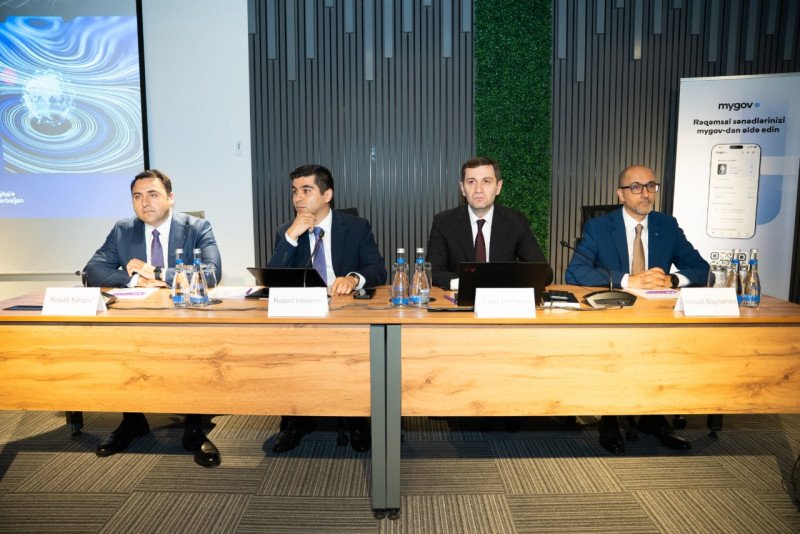
17 July 2026
The Ministry of Digital Development and Transport held a public hearing dedicated to legislative initiatives related to the innovation ecosystem, as предусмотрed in the “Action Plan for 2026–2028 on accelerating digital development in the Republic of Azerbaijan.”
At the event, Deputy Minister of Digital Development and Transport Rashad Hasanov, Advisor to the Minister Rashad Bayramov, Head of the Ministry’s Digital Development and Innovation Department Rashad Khaligov, and Chairman of the Board of the Innovation and Digital Development Agency (IDDA) Farid Osmanov delivered speeches. Representatives of the banking sector, payment organizations, fintech and ICT companies, participants of the innovation ecosystem, investors, and experts also attended the public hearing.
In his remarks, Deputy Minister Rashad Hasanov stated that the Action Plan for 2026–2028 serves as the main roadmap for the country’s digital transformation. It was noted that the Action Plan covers 4 strategic directions, 4 supporting factors, and a total of 58 initiatives.
The Deputy Minister emphasized that the strategic directions of the Action Plan include digitalization, artificial intelligence, innovation, and cybersecurity. The main objective across these areas is to integrate digital services for citizens, businesses, and the government into a unified ecosystem, apply artificial intelligence as a strategic development tool, establish an innovation ecosystem along with its supporting legal framework, and strengthen national digital resilience. Rashad Hasanov noted that within the innovation track, the goals include enhancing the financial sustainability of the innovation ecosystem, increasing ICT exports, and transforming Azerbaijan into a regional technology hub.
Rashad Hasanov also called on participants to actively benefit from emerging opportunities, noting that legislative initiatives and proposed incentives will create favorable conditions for the development of innovative businesses, the formation of competitive technology companies, the attraction of new investments, and the expansion of ICT exports. Effective utilization of these opportunities by the private sector will significantly contribute to the development of the country’s innovation ecosystem and Azerbaijan’s ambition to become a regional technology hub.
Following this, Chairman of the Board of the Innovation and Digital Development Agency Farid Osmanov delivered a presentation on the work carried out and the legislative initiatives developed within the framework of the Action Plan.
It was stated that the legislative package prepared to achieve these goals represents one of the most comprehensive reform initiatives forming the legal foundation of Azerbaijan’s technological development. The package предусматривает amendments to 33 laws, 9 presidential decrees, and 3 Cabinet of Ministers decisions. The main goal of the reforms is to transform Azerbaijan into one of the most attractive regional hubs for technology companies, innovative businesses, and investors.
The presentation also covered the establishment of legal frameworks for widely used international investment instruments such as SAFE and Convertible Notes for acquiring future equity in startups, the introduction of Employee Stock Ownership Plan (ESOP) mechanisms, tax incentives for venture investments, legal regulation of crowdfunding activities, oversight mechanisms of the Central Bank, protection of investor rights, and financial monitoring requirements.
Additionally, proposed changes aimed at encouraging research and development (R&D), providing tax incentives for the commercialization of intellectual property, supporting innovation experiments from legal and tax perspectives, introducing a “Digital Nomad” visa, liberalizing currency operations for technology companies, simplifying international payments, and creating special opportunities for startups in public procurement were presented to participants.
Within the framework of the public hearing, extensive discussions were held on the proposed legislative changes related to crowdfunding, venture capital funds, and financial-banking aspects within incentive projects. Participants’ questions were addressed, and their suggestions and feedback were heard.